
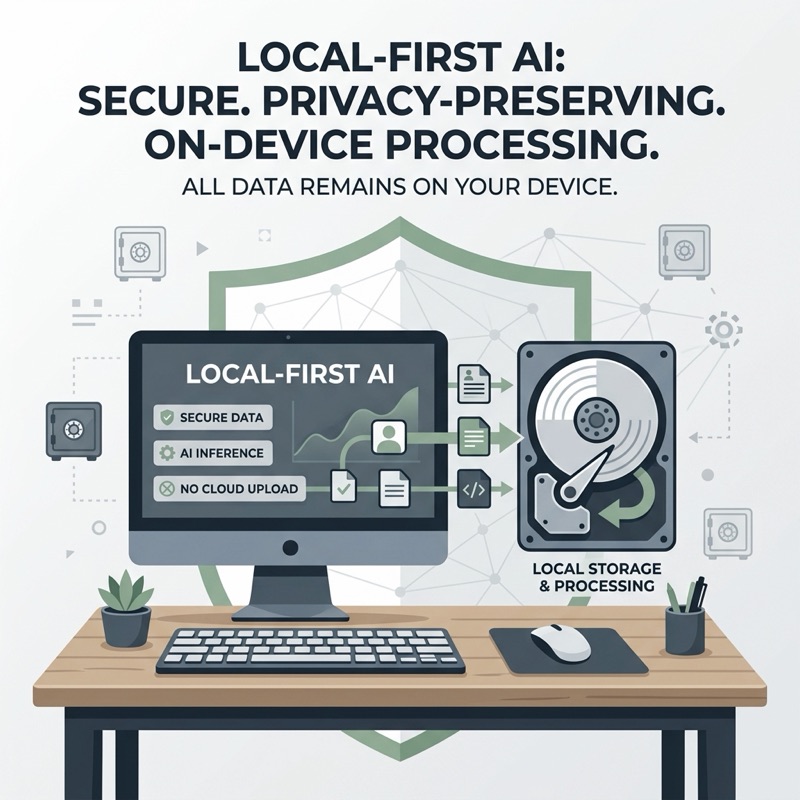
On-device smart computing has fundamentally changed the speed and scope of modern knowledge work. From instant speech-to-text meeting summaries to unified project indexing and intelligent search, local systems are no longer experimental additions—they are essential workspace layers.
However, this utility has historically extracted a heavy toll: control over sensitive work content. Standard cloud-based tools operate on a centralized upload model. To summarize a meeting, search a brief, or extract action items, you are often asked to pipe sensitive business recordings and internal documents across public networks to remote data centers.
"Cloud services ask you to upload your work. A local-first workspace brings the intelligence directly to your work — locally, privately, on your Mac."
In response, a powerful new technical paradigm has emerged: the Local-First Smart Workspace. By leveraging massive improvements in on-device hardware acceleration, local-first software can keep work content under local control and make cloud upload an explicit product decision rather than the default.
1. The Strategic Shift: Policy vs. Architecture
When evaluate software privacy, traditional security approaches rely on policy-based trust. Organizations evaluate vendor contracts, review SOC2 certificates, and depend on promises: "We promise not to train our models on your files" or "We promise to encrypt your transcripts at rest."
But policy is not the same as a technical boundary. APIs change, databases are breached, cloud endpoints are intercepted, and shadow AI usage can bypass corporate governance rules.
A local-first architecture establishes architecture-based trust:
- No Cloud Work-Content Upload: Runtime processing happens on your device, so meeting and project content is not sent to DaySpire servers.
- Local-First Sandbox: Transcripts and work memory stay in the Mac app’s local storage boundary unless you deliberately export them.
- Offline Resilience: The models compile and run natively. You can transcribe, index, and query your database during a flight or in a remote workspace without an active internet connection.
The Local-First Thesis
As framed by researchers at Ink & Switch, local-first software prioritizes ownership, long-term data preservation, user control, and privacy-preserving storage patterns, allowing applications to function seamlessly offline and retain immutable logs.
2. Technical Foundations: Bringing Local Smart Tools to Your Mac
Running modern high-fidelity transcription and natural language processing locally requires exceptional computational efficiency. In the past, desktop machines struggled to execute large neural nets without burning excessive CPU cycles and battery.
Three key advancements in 2026 have made local-first workspaces incredibly fast and efficient:
A. Unified Memory and Apple Silicon
Apple's unified memory architecture allows modern M-series chips to share a single, ultra-fast memory pool between the CPU and the GPU/Neural Engine. This means a localized speech model or language model does not need to copy heavy weights back and forth across different bus interfaces. Frameworks like Apple's MLX and highly optimized native Swift-Rust interfaces utilize Metal performance shaders directly, executing inference tasks with minimal battery drain.
B. Native In-Process Compilation (UniFFI & Rust)
Many local developer tools run an administrative background process bound to a local TCP port (e.g., `localhost:11434`), forcing the front-end to make local HTTP requests to exchange tokens.
DaySpire avoids that local-server class of risk by packaging core Rust logic (`localledger-core`) with Mozilla's UniFFI and linking it to the macOS Swift framework. Runtime model operations stay inside app-owned local processes without exposing a configurable model host.
// Pure native in-memory model execution snippet
let core = LocalLedgerCore.init()
let transcript = try core.transcribeAudio(filePath: "/path/to/meeting.wav")
let summary = try core.generateSummary(transcript: transcript)
C. Highly Compressed Edge Models
On-device language and transcription models are compressed into highly efficient, quantized formats. These models deliver near-cloud levels of accuracy for localized transcription, action-item extraction, and contextual search while requiring minimal system RAM.
3. The Private Memory Graph
A true local workspace is more than just a single offline chatbot. It must act as a private intelligence layer across all your everyday work context:
- Audio Ingestion: Local microphone recordings are instantly converted to speaker-diarized text using local speech-to-text engines.
- Document Hashing: Every markdown file, PDF draft, or manual calendar entry imported by you is hashed using SHA-256 for duplicate avoidance.
- Encrypted Storage: All data resides within a local database protected by AES-256 SQLCipher encryption, bound to your personal macOS Keychain.
- Vector Retrieval: An embedded index converts files and transcripts into local numerical vectors, letting you query your memory graph offline.
Conclusion: Own Your Intelligence
If your day-to-day work involves confidential client strategy, trade secrets, clinical patient consultations, or proprietary code architectures, uploading your files to public clouds is a structural compromise.
A local-first smart workspace shows that you do not have to choose between useful automated productivity and clear privacy boundaries. By bringing private work-memory tools directly to your Mac, DaySpire helps keep work content under your control.